
Some places are beautiful.
Some places are historic.
And then there are places that leave you silent.
The Cellular Jail in the Andaman Islands is one of them.
I went there expecting to see an old colonial prison. I left with a completely different understanding of freedom, sacrifice, and resilience.
This is not just a monument. It’s a reminder.
What Is the Cellular Jail?
Located in Port Blair, the Cellular Jail was built by the British between 1896 and 1906. It was designed to exile and isolate Indian freedom fighters far from the mainland.
The prison was nicknamed “Kala Pani,” meaning black waters — a punishment so severe that it meant social death along with physical imprisonment.
Thousands of revolutionaries were sent here, cut off from family, homeland, and hope.
But what struck me most wasn’t just the structure — it was the intention behind it.

Why It Was Built
After the Revolt of 1857, the British government realized they needed a way to crush revolutionary movements more effectively.
The Andaman Islands were remote, surrounded by deep seas, and nearly impossible to escape from. Perfect for isolation.
The Cellular Jail was designed with:
- 7 wings
- 3 floors
- 693 solitary cells
Each cell measured roughly 13.5 by 7 feet. No dormitories. No communication. No connection.
The architecture itself was psychological punishment.
The wings were arranged in a radial pattern, so prisoners could not see or speak to one another. Isolation was the weapon.
Standing inside one of those cells changed something in me.
The Stories That Stayed With Me
Many of India’s most courageous revolutionaries were imprisoned here.
Vinayak Damodar Savarkar spent years in solitary confinement inside these walls. Countless others endured forced labor, physical torture, hunger strikes, and brutal punishments.
Prisoners were made to:
- Crush coconuts
- Extract oil using heavy manual grinders
- Work under unbearable heat
Failure meant flogging.
But despite the torture, many refused to surrender their beliefs.
And that is what shook me the most.
The Light and Sound Show That Hits Hard
If you visit Cellular Jail, stay for the evening light and sound show.
As darkness falls, the prison walls become the narrator. Voices echo stories of struggle and sacrifice. The atmosphere grows heavy.
It doesn’t feel like a tourist attraction. It feels like testimony.
You don’t just hear history — you feel it.
And suddenly, freedom doesn’t feel abstract anymore.
What Changed in Me
Before visiting Cellular Jail, freedom was something I took for granted. It was a word in textbooks, a holiday on the calendar.
After walking through those narrow corridors, it became personal.
It made me think:
- Would I have had the courage to endure that suffering?
- Would I have survived years of isolation?
- Would I have sacrificed everything for an unseen future?
History became human.
The Cellular Jail forced me to confront the cost of independence — not in numbers, but in names and faces.
Today’s Cellular Jail
Today, only three of the original seven wings remain. The rest were demolished after independence.
The site is now a national memorial.
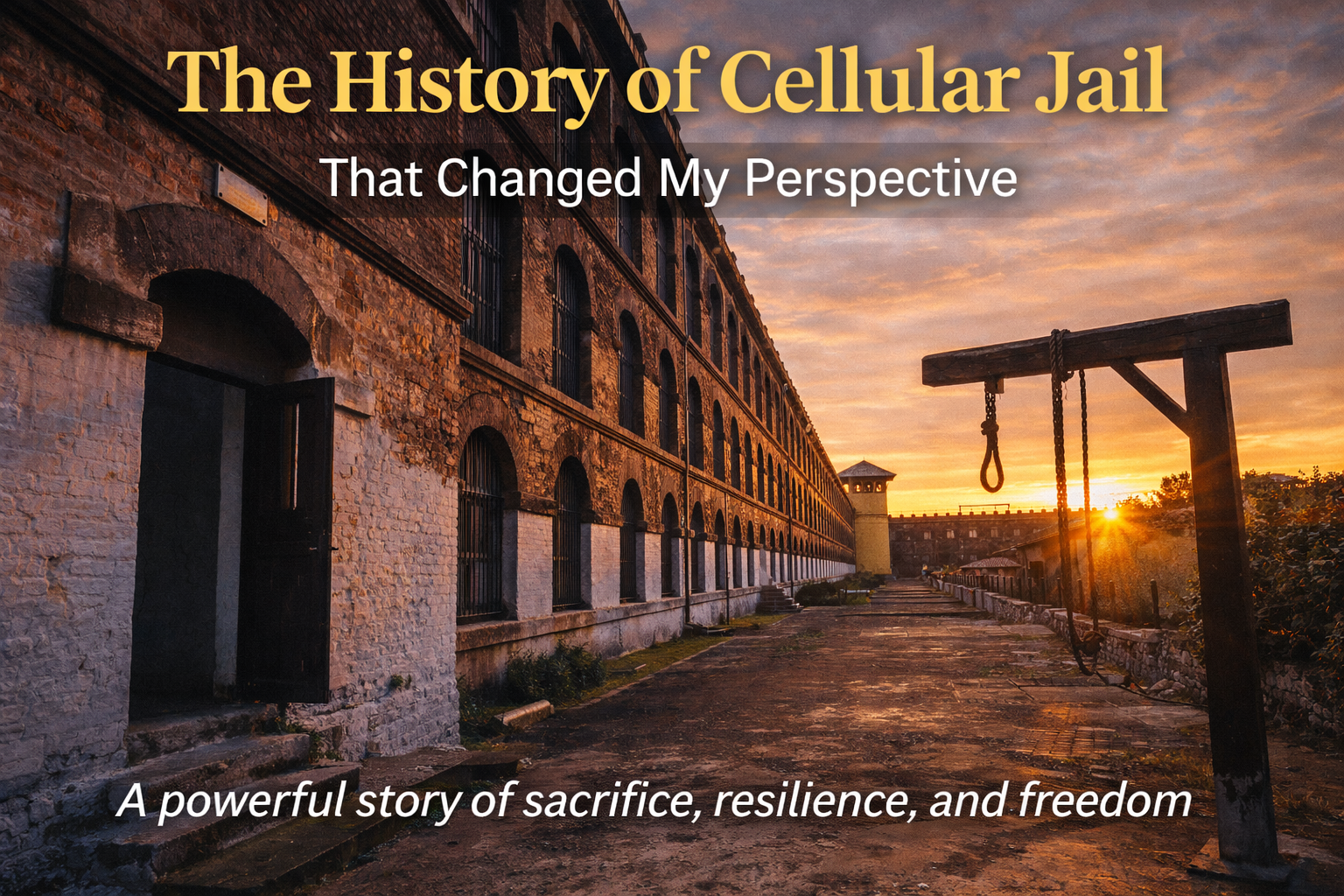
Visitors walk through the same corridors once filled with silence and suffering. The gallows still stand. The cells still hold echoes.
It is preserved not to glorify pain — but to remember it.
Why Everyone Should Visit Once
Cellular Jail is not a place you visit for photographs.
It’s a place you visit for perspective.
It teaches you that:
- Freedom was earned, not gifted
- Sacrifice often happens in silence
- Strength is sometimes invisible
You walk in as a tourist.
You walk out reflective.
Final Thoughts
The history of Cellular Jail changed my perspective because it stripped history of its distance.
It reminded me that independence came at a cost that cannot be measured in pages of a book.
Some journeys are about landscapes.
Some are about luxury.
And some are about learning who we are because of those who came before us.
At Tripoventure, we believe travel should go beyond sightseeing. It should inspire reflection, understanding, and connection. Visiting Cellular Jail is not just about exploring the Andamans — it’s about honoring resilience, courage, and the true meaning of freedom.
Sometimes, the most meaningful journeys are the ones that change how you see the world — and yourself.