There are mountain views you admire — and then there are mountain views you feel.
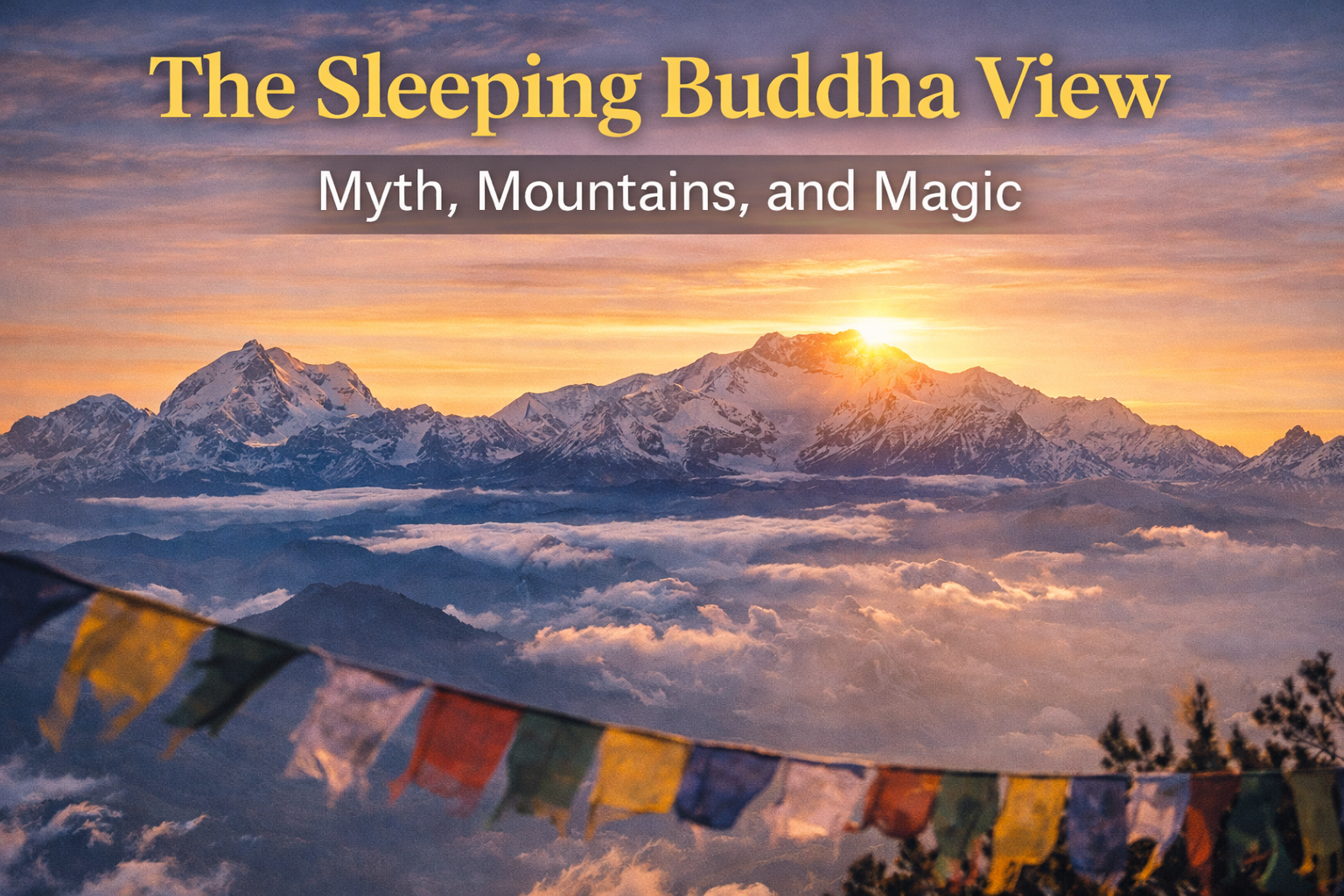
The Sleeping Buddha View in the Eastern Himalayas is one of those rare sights that quietly takes your breath away. At first glance, it’s just a snow-covered mountain range glowing under the rising sun. But look closely, and the peaks align to form the shape of a reclining Buddha.
Head, chest, knees, and feet — perfectly outlined against the sky.
It’s not just geography. It’s magic shaped by nature.
What Is the Sleeping Buddha View?
The Sleeping Buddha is a natural rock formation created by the alignment of Himalayan peaks, primarily including Mt. Khangchendzonga and its neighboring summits.
When viewed from specific locations in North Bengal and Sikkim — especially Sandakphu — the range resembles Lord Buddha lying in repose, facing the sky.
The “head” is believed to be Mt. Kumbhakarna (also known as Jannu), while the main mass of Kanchenjunga forms the body.
It’s one of the few mountain silhouettes in the world that carries both spiritual symbolism and geological wonder.

Where Can You See the Sleeping Buddha?
Sandakphu
Sandakphu is the most famous viewpoint for witnessing the Sleeping Buddha in its full glory. At sunrise, the snow peaks turn golden, and the shape becomes clearly visible against the glowing sky.
On clear days, you can also see four of the world’s five highest peaks — Everest, Lhotse, Makalu, and Kanchenjunga — making the experience even more surreal.
Darjeeling
From certain viewpoints in Darjeeling, especially early in the morning, the outline of the Sleeping Buddha can also be seen — though not as dramatically as from Sandakphu.
Pelling (West Sikkim)
Pelling offers another beautiful angle of the Kanchenjunga range, where the reclining shape appears softer but equally mesmerizing.
The Myth Behind the Mountains
Local legends say the formation represents Lord Buddha in eternal rest, blessing the land below.
For many locals, the mountains are sacred. Kanchenjunga itself is considered a guardian deity in Sikkim. Climbers traditionally stop just short of the summit out of respect for its spiritual significance.
The Sleeping Buddha is not just a visual illusion — it carries cultural and religious meaning deeply rooted in Himalayan traditions.
When locals look at the peaks, they don’t just see snow. They see protection, peace, and presence.
Why Sunrise Changes Everything
You can see the mountain range at any time of day, but sunrise is when the magic truly unfolds.
As the first light hits the peaks:
- The “face” glows softly in gold
- Shadows define the body
- The sky shifts from deep blue to warm orange
The transformation lasts only a few minutes. It’s quiet. It’s subtle. And it feels deeply personal.
Travelers often describe the moment as spiritual — even if they didn’t expect it to be.
A Photographer’s Dream
The Sleeping Buddha View is one of the most photographed Himalayan landscapes, but no camera truly captures its depth.
The layered ridges, shifting clouds, and changing light create a constantly evolving canvas.
For photographers, winter and post-monsoon seasons offer the clearest views. Crisp skies sharpen the outline, making the reclining shape unmistakable.
More Than Just a View
What makes the Sleeping Buddha special isn’t just the mountain formation — it’s how it makes you pause.
In a world of fast itineraries and quick photo stops, this view demands stillness. You wait for clouds to clear. You stand silently as the sun rises. You watch shadows move across the peaks.
It reminds you that nature creates art without trying.
And sometimes, the most powerful experiences are the quietest ones.
Best Time to Witness the Sleeping Buddha
- October to December: Clear skies, sharp mountain views
- March to April: Rhododendron blooms with bright Himalayan mornings
- Winter (January–February): Snow-covered landscapes, but colder conditions
Avoid peak monsoon months if clear views are your priority.
Final Thoughts
The Sleeping Buddha View is not just a scenic attraction — it’s a moment of connection between myth and mountain, culture and landscape.
Whether you see it from Sandakphu, Darjeeling, or Pelling, the experience stays with you long after the journey ends.
At Tripoventure, we believe travel should offer more than just destinations — it should offer stories. And the Sleeping Buddha is one of those rare stories written in snow, light, and silence.
If you’re ready to witness this Himalayan magic for yourself, your journey begins with choosing the right path to the mountains.